In paying respects to #RASpark – this week, I pursued the goal of providing $15 worth of nutrient-rich foods to two homeless persons in the neighborhood (Hyde Park, Chicago) each day, and making sure to chat with each person about their diet and the importance of being mindful of what you eat.
Over this past week, I chatted with various persons who seemed to be living on the streets in Hyde Park. To my surprise, most people I chatted with expressed that they are all set in terms of food. Most interactions involved being told that a local store and/or restaurants have offered to provide homeless persons with food until they get off the streets–some requiring payment (of an amount that I was not able to collect information on), and some requiring no payment.
Finding out that food security is more or less not an issue for homeless folks in Hyde Park was an amazing discovery. But it left me in a situation where I began to question how worthwhile it is to pursue my goal of providing nutrient-rich foods to homeless persons. One person, Aaron, said that he would like some cash in order to get off the streets; and I was apt to wonder afterwards “What would help him get off the streets? Some sort of assistance program?”
As someone of a musical theatre background, I was also apt to try and put myself in the shoes of someone homeless. In assuming the position and thinking about my own feelings in such a scenario, I came to believe that there’d be a particular way in which I’d prefer to get off the streets. Sure, my goal would be to get off the streets, but I’d most appreciate being helped out by others little by little, feel as though I’m lifting myself up, feel as though I’m finding success through my own power, and/or feel like G-d is helping me. I might feel as though fellow human beings are entities that I can’t rely on or trust too much [and think to myself, “if the opposite were true, I wouldn’t be homeless“]. If a fellow human being is helping me, I’d have to think that it’s because there is a catch: if someone were to ask me “Why don’t you believe that I care about you?”, I’d say “people have looked away from me, ignored my presence, and brushed my words off their shoulders enough for me to understand that people care more about appearing generous than about being generous.”
I decided to continue with the goal of providing food to people, as there is always something to be gained through persistence. Through persistence, the way I was going about helping homeless persons felt like I was just venting or releasing energy from a place of frustration. I walked or ran up to people, asking them “How are you doing? Could you use some food?” As I went up to person after person, I found myself face-to-face with the fact that I’ve been operating off of stereotypes of people who are homeless, approaching people who “look homeless,” and positioning myself to make a fellow human being feel belittled. I found myself feeling like a bully, like I was soliciting homeless people for information, and like I was someone who didn’t care too much about whether or not a person enjoyed my presence or not; I just needed to make my quota of 2 people per day, or 10 persons in total. I felt back then–and feel now–like this sort of energy is dangerous to use as motivation. I came to feel, “if I let myself be driven by a quota, I might become someone who perpetuates the circumstances that force people into homelessness.”
On Wednesday, I had my first success! A beautiful day in the 70s—maybe low 80s—with spotty clouds, sunshine, a little bit of humidity, and fickle-hearted wind. As I felt the sun on the skin of my arms, riding my bike through E. 53rd Street towards Lake Michigan, I took some time to survey the blocks for prospective nutrient-rich food-accepting persons. To my surprise, I chatted with someone about their diet, and bought food for them. This person’s name was “Lou.” Lou has been in Chicago for a while; just had surgery done on their body, asked for some mashed potatoes, and asked for support with traveling northwards. After chatting with Lou for some time, and purchasing mashed potatoes for him, Lou’s face featured a smile and watery eyes [that looked joyful].
After going out on Monday, Tuesday, and Wednesday, I reflected on my progress: in providing 1 person with food over the course of three days, I failed to meet my quota of 2 persons per day; and I chatted with people about their diets, with most conversations consisting of me asking “Do you have veggies in your diet?” and me hearing back “Yeah.” With the busy, end-of-the-year affairs of my full-time job at the University occupying my time and energy while accompanied by efforts aimed at providing homeless persons with food, I decided to hang back at home on Thursday and Friday, facilitate rest for both my body and mind, and come up with an idea for a new goal.
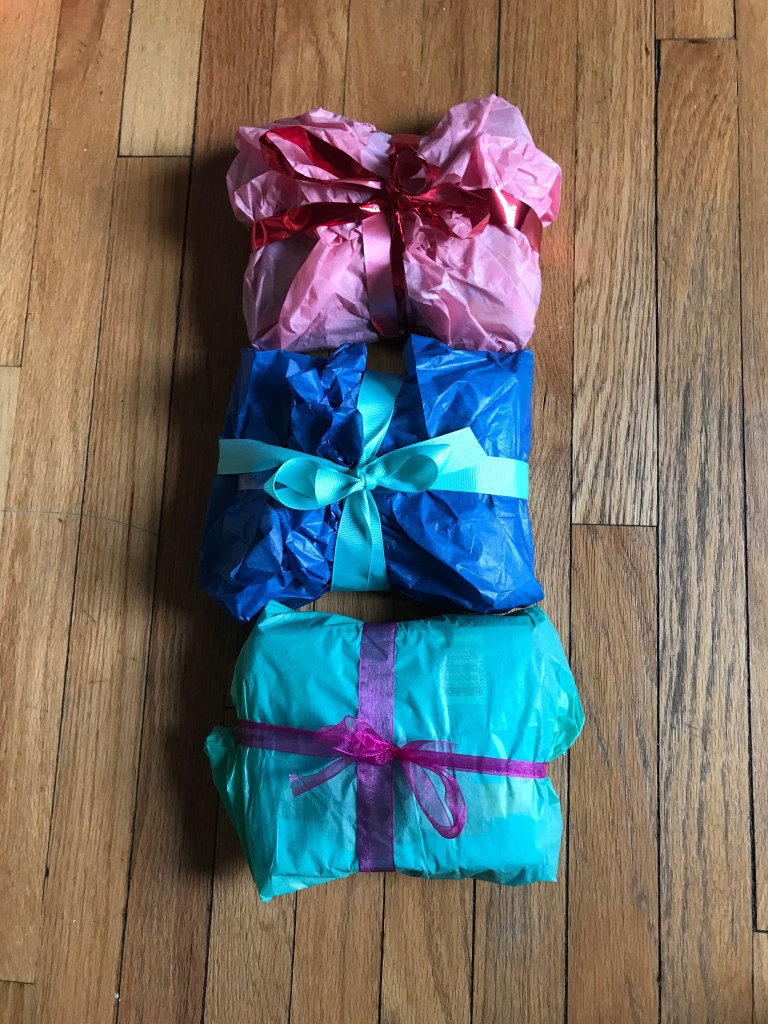
In reflecting on the experiences from the past days, I recalled that everyone I chatted with asked for cash and/or help with traveling somewhere. In paying respects to this, and in paying respects to my feelings of uncertainty about trying to provide food to people, I decided to distribute 3 “Appreciation Gift Packs” to homeless persons, each including some Ventra (public transit) tickets, a Visa gift card, a poncho, a couple of think! protein bars, a couple of Nature Valley nutrition bars, a few packs of Welch’s fruit snacks, and a homemade bookmark/card.
As I went to purchase new materials for the “Appreciation Gift Packs,” I found myself looking at someone who appeared to be a veteran, asking for cash, outside of Walgreens; and I wanted to avoid interaction with them. In walking away from them, I came to a hard stop, and reflected on the fact that I chose to walk away from them. I came to realize that the more humane a homeless person appears to be–and/or the more a homeless person resembles someone that I am familiar with–the more opposed my heart is to the idea of getting involved with them. I came to realize here that I wish to avoid becoming “too involved” with those who need help; and I thus came realize that, while lessons taught by your beloveds should be valued, I need to unlearn how my beloveds have taught me to treat homeless persons.
Prior to this week, I saw homeless persons as a population that deserves more attention than they currently receive. While this still stands true, my perspective has shifted slightly– and my focus is now less on homeless persons, and more on me. Arguably, the person who needs the most help is me; and I have to keep in mind during the coming days that real change comes from within. In this case, the ways in which homeless persons are treated by others can undergo improvements only if I begin to treat homeless persons differently myself.
As I think about the idea that “you have to take care of yourself before you can take care of others,” I am apt to think about the fact that prioritizing yourself over others can mean many different things. Historically–to me, and as it pertains to living alongside homeless persons–prioritizing myself over others has meant “not giving too much money out,” “being strong enough to say no,” and “being able to not pay any attention to someone asking for help.” Prioritizing myself over others now means thinking about what makes me be and become who I want to be and become. The person that I want to be and become is someone who treats others like they are human; and, in thinking about how I can be and become such a person, I have to really acknowledge that, every time I avoid lending a homeless person my ear, attention, and/or resources, it hurts. I have to be wary about reinforcing the part of my drive that is bound to make me into opposite of what I want to be and become.
Thank you to all, persons and initiatives, that have sparked the experiences and thoughts outlined here.
 Pasfut Trailblazing